Posted on Leave a comment

The Time Tider – a Q&A with Sinéad O’Hart

What is The Time Tider about?

The Time Tider is the story of Mara Denbor, a girl who has always lived with her dad, Gabriel, in the back of a van which they’ve customised to hold everything they need. They’re constantly on the move, and Mara’s dad gives her the impression that this is because a mysterious ‘someone’ is after them. Mara has never questioned it, despite the many difficulties they’ve encountered over the years, until she stumbles upon some of her father’s many secrets and realises that he hasn’t been telling her anything like the whole story. For her dad isn’t just her dad; he’s also the Time Tider, a person whose job it is to gather up deposits of unused or wasted Time from anywhere in history – and then, just as Mara’s getting her head around that, her dad is kidnapped…

Tell us a bit more about the world Mara and Jan lives in, is it a contemporary world? 

Mara, Gabriel, and Jan’s world is indeed a contemporary one. It’s based on modern-day Ireland, and the place-names I’ve used can be mapped on to or have some relationship with towns and areas in Wexford, where I grew up, as well as Dublin (which goes by its own name in the book). Derrinfield is a fictional place though I imagine it as a little like several of the towns in the Irish midlands, where I live now. However, I have taken liberties with some of the distances involved! In reality, ‘Whiteharbour’ and ‘Port Ross’ are a lot closer than they are in The Time Tider, even if you are driving on back roads.

How did you come up with the idea of The Time Tider?

The idea for The Time Tider was one of the first I ever had, back in my early twenties (a long time ago now!) when becoming an author was a dream I never imagined would come true. I was studying for a PhD in English literature at the time, and one day as I read a very interesting book (Time, Work and Culture in the Middle Ages by Jacques LeGoff) I came across a discussion about the history of time and timekeeping, and how ideas about time completely changed once clocks, and clock-towers, became common throughout Europe. Once upon a time people used nature, or their own bodies, to tell the ‘time’ – so, they rose and went to bed with the sun, they ate when they were hungry, and so on. But when clocks ‘regularised’ time, people started rising when the clock struck six, and eating when the clock struck one, and something about that grabbed my imagination. I remember excitedly thinking: what if this change created a gap between the two ‘Times’? And what if the gap between these two Times filled up with wasted time? Or unspent time? And if that could happen, and someone was able to go back and collect all that wasted time – what would they do with it? And so, The Time Tider was born. I have tried to write it at least five times over the past twenty years, and I’m so glad that I’ve finally found the right way to write it. Sometimes, writing things the wrong way first is really important!

What are you most excited to share with readers of your new children’s book?

I’m excited to share the setting of this story, as it’s my first contemporary setting. All my other books have had historical settings, or at least pretend-historical settings; The Time Tider is the first book I’ve written which features mobile phones, cars, modern-day problems like homelessness, poverty, sickness, and parents who might not have their children’s best interests guiding their decisions (at least, not all of the time). I really love Mara, my central character, and how brave and clever she needs to be to work out all the secrets of her family while also just surviving in a tough situation, and I also love Jan, her new friend, who’s facing challenges of his own. I enjoyed writing their very different family situations and working through their growing friendship, which felt so real to me. So, I guess I hope readers will feel I did a good job handling the setting, and that they’ll love Mara and Jan as much as I do. 

What did you find challenging when writing The Time Tider?

I think, with any book that mentions time-travel, even in a sideways sort of way like I do in The Time Tider, things can get complicated pretty quickly! I think the most challenging part of this book was getting my ideas about how the timey-wimey bits work clear in my head, and then getting them on to the page without mangling them too much. I was gently encouraged several times during the writing and editing process to simplify things, and my editors had a pesky habit of asking me really tough questions – ones I didn’t want to think about! – so that we got the clearest version of the story on to the page. It was quite tough at times but I’m so glad we all persevered, as I’m really proud of the final version of the story and I hope it’s not only clear, but also interesting, exciting, and thrilling!

What children’s books would you recommend to young readers that have entertained and inspired you?

This is a question I could answer for the rest of my life! I co-host a podcast called Storyshaped with another children’s author, Susan Cahill, where we ask people questions like this one, and I’ve often thought of the stories that have shaped me, and my life. The ‘classic’ children’s books that I read when I was a child myself and which definitely inspired and entertained me would include Elidor by Alan Garner, A Wrinkle in Time by Madeleine l’Engle, The Little Prince by Antoine de Saint-Exupery, Hounds of the Morrigan by Pat O’Shea, and so many others. But right now there are brilliant children’s books being published every single week: there is no shortage of excellent stories out there to entertain, inspire, and amaze. One of the best books I’ve read this year is Sharon Gosling’s The Extraordinary Voyage of Katy Willacott, which deserves to win all the prizes and sell millions of copies – it really is extraordinary! I’ve also loved The House of Shells by Efua Traoré, Jummy at the River School by Sabine Adeyinka, The Strangeworlds Travel Agency books by LD Lapinski, Rebel Skies by Ann Sei Lin, The Chestnut Roaster by Eve McDonnell, and a stunning picture book by Irish author Olivia Hope with pictures by Daniel Egnéus called Be Wild, Little One has been inspiring me since the first moment I saw it. I hope you go out there and find the book or books for you, and don’t forget to ask your local librarian or bookseller for help and tips if you get stuck.

Any tips for aspiring writers?

I always tell young or aspiring writers to follow my ABC – Always Be Curious. If you bring curiosity with you as you navigate the world, you’ll never be short of ideas and inspiration. I’m forever asking questions about things – usually, inside my head! – and it helps me to see things differently; the crack in the pavement is a portal to another world, or the bird flying overhead is a dragon in disguise, or the scattered stones on the ground are lost teeth from the tooth fairy’s bag, or anything you like! Every time you go for a walk, or every trip you take to the shops, or every journey to football practice, or whatever you might find yourself doing, will be packed with stories and potential stories if you use all your senses to find them. So, soak up the world around you every day, and you’ll find yourself picking up nuggets of inspiration I like to call ‘story seeds’, which will take root inside your imagination and sprout one day into something amazing. And, most importantly of all: never leave home without your notebook! As soon as you are struck with an idea, write it down or draw it out straight away, or that tricky, slippery little thing will be off into the air again, looking for another head to land in. And the last thing: write for fun, enjoy yourself, and don’t judge your own work too harshly. Take it easy on yourself. Creating is tough work! Stick with it, and never lose the joy.

The Time Tider
Posted on Leave a comment

The joy of book clubs by YA thriller writer Tracy Darnton

My latest thriller Ready or Not is just out. Teenager Kat disappears during a game of hide-and-seek at a late-night party on holiday in Cornwall. For years, three families have holidayed together at Creek House so the ‘Creekers’ have grown up together. I tell the story through Millie, the youngest, who’s devastated by the absence of best friend Kat. One year on, the remaining teenagers head back to Creek House.

One of my favourite author things to do is join in with a book club talking about one of my thrillers. All authors love to talk about their books and this is the way to have a group of engaged bookish kids or adults delighted to talk about it – what could be better! And often the organiser has gone to town on the refreshments and nibbles. I’m hoping for some Cornish fudge when talking about Ready or Not…

I’ve been to book clubs with bookshops and libraries or schools – and even the WI. Of course, the last couple of years have meant joining online once schools were back in action. Either way, I’m always asked such interesting questions – often people have seen something new in my books I didn’t know was there.

I’m in two clubs myself – one is with fellow writers and we alternate reading Middle Grade and YA. We’re always reading as writers, so looking at how the author has artfully worked in backstory or authentic dialogue. My pet topic is endings – especially in thrillers. I’m always on the lookout for a delicious twist and seeing how that has been foreshadowed by the author – how have they laid the groundwork so that the twist works well as though a switch has been flicked and it all makes sense?

I find writing discussion questions for my own novels a useful part of the development of the story. It helps me to crystallise what the book is about and to think about issues which will be of interest to my readers, who are at the stage of life where they are asking questions about self and society. So Ready or Not has questions about the writing, or craft, like: “How are games used in the book?” and ones to provoke more wide-ranging discussion about friendship, obsession or privilege like: “Is Noah right that he’ll be treated differently from the privileged Creeker teens? What does the future hold for him?

I can’t wait to pop along to some book clubs to hear what readers have to say about Ready or Not.

Ready or Not is available now

You can follow Tracy on Twitter or Instagram @TracyDarnton

Posted on Leave a comment

Bringing Old Friends to Life by Bryony Pearce

WARNING – This post contains spoilers for Savage Island

When I went to the Wirral Book Awards with my standalone horror novel, Savage Island, I wasn’t expecting to win, but I love a good book award, especially those voted for by young readers, so I went for the craic, as they say.

My performance there ended with a Q&A, during which one boy put up his hand and asked if there was going to be a sequel.

Now, as Savage Island was written as a standalone horror novel, you can imagine how many survivors there were (I’ll give you a clue – more than zero, less than two!). This would make writing a sequel extremely difficult. I assumed he was joking.

Laughing, I threw his question back to the crowd. ‘Who else wants a sequel?’

Hands flew up. So many hands.

Hang on, were they serious?

‘Do you mean a sequel or a prequel?’

‘Sequel!’

‘With the same characters or different ones?’

‘The same ones!’

This audience of avid young readers wanted me to write a sequel with the same characters … who were all (bar one) meant to be dead.

I returned to my car clutching my prize (reader – I won the award!) and thinking. Was there any way I could make this happen for them? And did I want to?

Well, there did seem to be more I could explore in this world. Savage Island was organised by a psychopathic billionaire, seeking more psychopaths to expand his empire, over whom he would have control, via means of recordings that showed them committing atrocities.

But what if he wasn’t just finding these psychopaths via means of personality testing, what if he’d been trying to createthem? What if Savage Island was just part of a programme that Grady, Ben and Will didn’t know they were inside?

And what happens when Grady, the psychopathic anti-authoritarian conspiracy theorist ends up forced to work in a suit for a billionaire?

Who are the other teens in the ‘graduate recruitment programme’? Other survivors of ‘the island’ or does Gold have several different ‘recruitment campaigns’ running?

These thoughts stuck in my head. So, I started to wonder, how could I resurrect Ben and Lizzie?

At the end of Savage Island Ben wakes on a beach, to see the bodies of his brother, Will, and the girl he loves, Lizzie. Then Grady walks towards him with malicious intent. I had intended this to mean that Grady kills Ben, but what if he didn’t? What if Ben survives the encounter?

But how?

Then I thought about who Grady is – psychopathic, anti-authoritarian conspiracy theorist – would Grady want to be taking orders from an old white guy for the rest of his life? Wouldn’t he see the advantage in keeping Ben alive – Ben who now hates Gold and will do anything to destroy him?

So, I decided to, not only have Ben survive, but to have Grady save him.

Throughout Savage Island, Grady has been the go-to guy for medication. His doctor father sent him with every possible pill and painkiller, so it didn’t seem a stretch that he would be able to feed Ben some sleeping tablets, which would knock him out long enough for Gold’s cameras to be satisfied that Grady had done his job.

Neither is Ben stuffed with medical knowledge. Could he really know that Lizzie was dead, just by looking at her? What if Grady had done the same with her?

So, I had a way to save Ben and Lizzie. That gave me three characters to start the sequel with. Grady, working for Gold, but trying to find a way to get out and Ben and Lizzie in hiding, waiting for their chance to destroy him.

It was brilliant to be able to write more about these characters I thought I’d lost (killing off characters is something I do, only regretfully), to explore more about who they are and who they have become after surviving the island (they have changed in big ways).

So, thank you to the students at the Wirral Book Award who inspired me to resurrect these old friends and continue their story. I’m glad I was able to do so for you (and for me)!

If you want to know more about Cruel Castle, or any of Bryony’s other books, please visit her website: www.bryonypearce.co.uk, or follow her on Twitter or Instagram @BryonyPearce or TikTok @BryonyVPearce

Posted on Leave a comment

Drowned Worlds In Children’s Fiction by Nicola Penfold

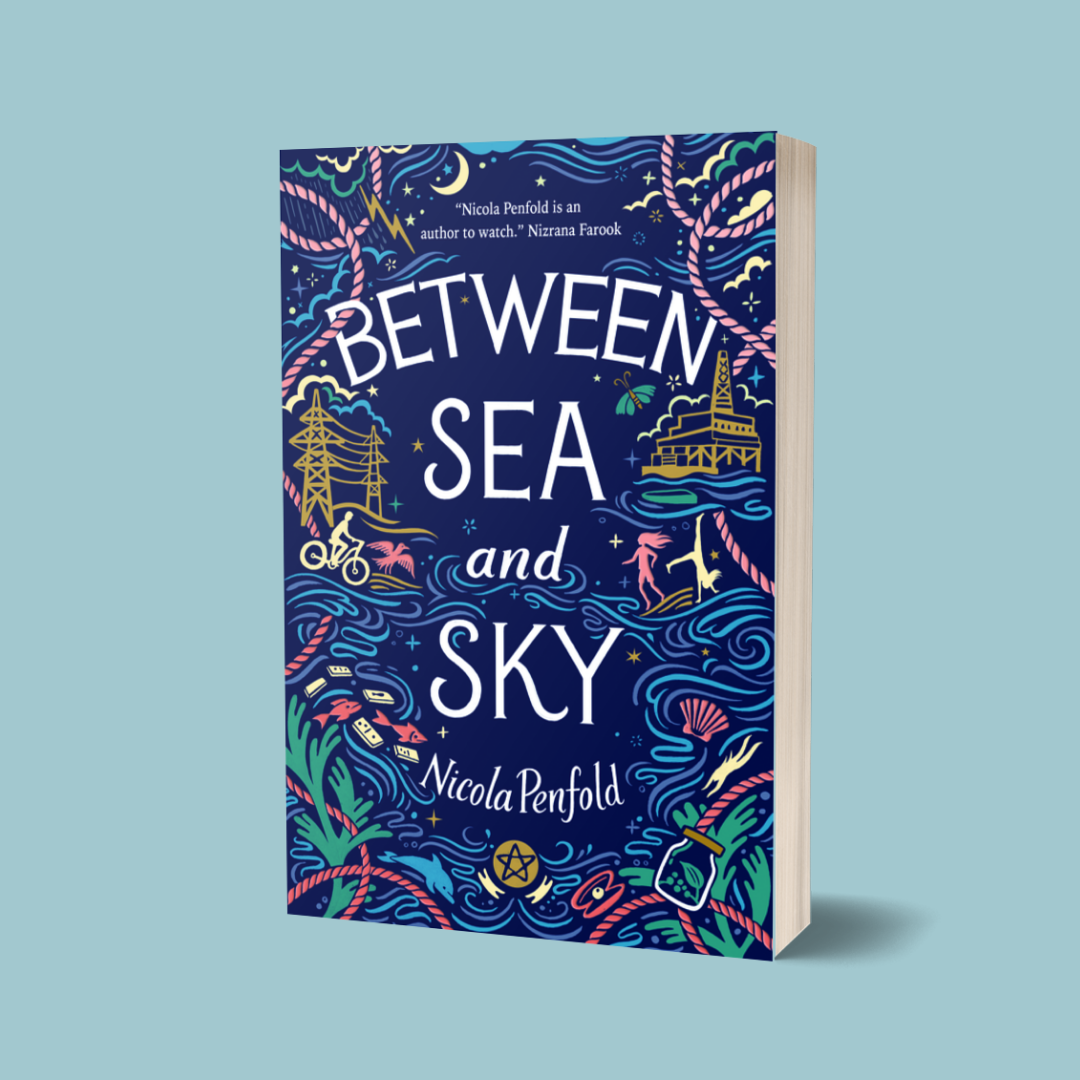
Between Sea and Sky is set in an imagined future, after sea levels have risen and many species have died out. On the flat south east coast of England, a small mainland population lives in a concrete and metal compound, built on stilts to protect it against flooding. The cooling tower of an old coal fired power station grows stacked rows of salad and vegetable plants, in artificial solutions and light. And vast fields of solar panels and pylons stretch inland, sending valuable electricity to the governing Central District.

Out at sea, a small family – one dad, two sisters – make their living on a ramshackle old oyster farm. A rusted cruise liner, now a prison ship, takes anyone who clocks up too many civil disobedience points on the tightly controlled mainland, where rules and restrictions are a way of life. This is my vision of a drowned Earth.

I’ve always been drawn to post-apocalyptic worlds. A small group of survivors in a changed landscape. One of my favourite books growing up was Children of the Dust by Louise Lawrence, set in the aftermath of a nuclear war. It’s bleak reading now, going back to it all these years later, but at the time I adored it.

Where the World Turns Wild, my first book, was set in a world after a pandemic had locked people in cities, away from the natural world. Between Sea and Sky is post climate change and biodiversity loss (these crises come hand in hand). It’s a scary vision, but the statistics are scary too. Sea levels are thought to have risen 16cm since the start of the twentieth century, but by far the biggest rises have been in recent decades. Levels are thought to be rising 3.6mm a year, and this is predicted to get faster still. If you go to https://coastal.climatecentral.org you can see what areas will be underwater by when, unless we take drastic action, and not only stop churning out greenhouse gases, but invest in solutions to reabsorb them.

I’m not of course the first children’s writer to write a flooded future. Marcus Sedgwick’s Floodland came out in 2000 and this short, brilliant, visionary book is still used regularly in schools. East Anglia is underwater and survivors live precariously on tiny newly formed islands, like that of Ely Cathedral (‘Eeels Island’). In a world of rival tribes, everything has become about survival.

Marcus Sedgwick said recently, writing on a new Climate Fiction League website, set up by writer Lauren James, that “just because we might think something is well-known, accepted scientific fact, doesn’t mean everyone does… That’s why it’s very important that we continue to speak (even at risk of boring ourselves) about the vitally important matters that need to change in the world – in this case, climate change. And of course, the best way to do this is to work with younger people.”

Fiction can show futures we want to avoid. But this material is not just futuristic. In Swimming Against the Storm by Jess Butterworth, Eliza and her sister Avery live in a fishing village in the bayous, the swamplands of Louisiana. This is an area under massive threat from rising sea levels and subsidence. It’s estimated that a football field of coastal wetlands is lost every hour into the sea in Louisiana. Swimming Against the Storm brings into sharp focus what this means, for this vitally important habitat, so rich in biodiversity that it sings with life in the book. And for the communities that live here, and make their living from the shrimp and oysters which have traditionally been so plentiful, the sadness at what’s being lost is palpable. The book draws attention to the added stresses that oil and gas companies are putting on the bayous, as they dig out new canals.

Bren McDibble is a New Zealand writer living in Australia, whose books have featured a world without pollinators (How to Bee), a world after a wheat fungus has destroyed cereal crops and caused famine (Dog Runner) and her own vision of a drowned world (Across the Risen Sea). I asked Bren why she chose this last topic.

“Sea inundation is a process that’s already a very real threat to so many cities around the world. By setting a story after a global sea rise event, I get to create a survival story in a new world. Seeing our world breaking up is now our scary daily news and I like to look beyond that. What comes next? I feel it empowers young readers to cope with an environmental topic if I focus on the survival and show characters thriving in a new (but changed) world.”

Across the Risen Sea pushes a message about low-impact lives – “living gentle lives” that will appeal to environmentally conscious readers (most young people today!). But I loved the playfulness too, and the inventiveness, in which this new world is rendered. There is a scene where the main characters, Neoma and Jag, climb the stairwells of a flooded office tower, its top floors poking out of the water. They’re looking for salvage. And in the book’s opening pages, the head of a baby doll, home to a hermit crab, clambers over sea walls made of old car frames. They live in ‘Rusty Bus’. These kinds of details were some of the things I most enjoyed writing in Between Sea and Sky – seeing what’s left of our world and what the characters make of it. One of my characters, Pearl, collects washed up broken dolls, and remakes them as mermaids, to release back into the sea. Her sister, Clover, tightropes the backbone of a beached whale skeleton.

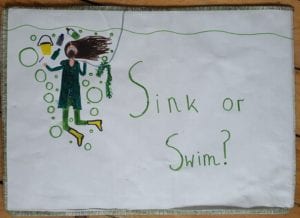
It’s a fine balance sometimes, writing something intriguing and inviting, a world where readers want to spend time, and sounding the alarm call loud enough. I was writing Between Sea and Sky last spring. We were all in COVID lockdown, and it felt important to pack the story full of hope. Hope comes in two forms in the book. My child characters who notice things adults are too busy and worn down to see. And the natural world, which has so much capacity to heal and help us, even now, after we’ve done so much to destroy it. I’m going to finish with a climate strike placard one of my daughters made last year. I hope we swim!

For other drowned worlds in children’s fiction try:

(for older readers / middle grade)

Flood World by Tom Huddleston

Orphans of the Tide by Struan Murray

(for young adults)

The Gracekeepers by Kirsty Logan

Useful Idiots by Jan Mark

Also check out https://climate-fiction.org/ Climate Fiction Writers League

Posted on Leave a comment

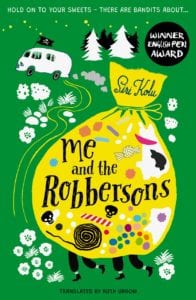
Me and the Robbersons. A gift of love to my son. Siri Kolu.


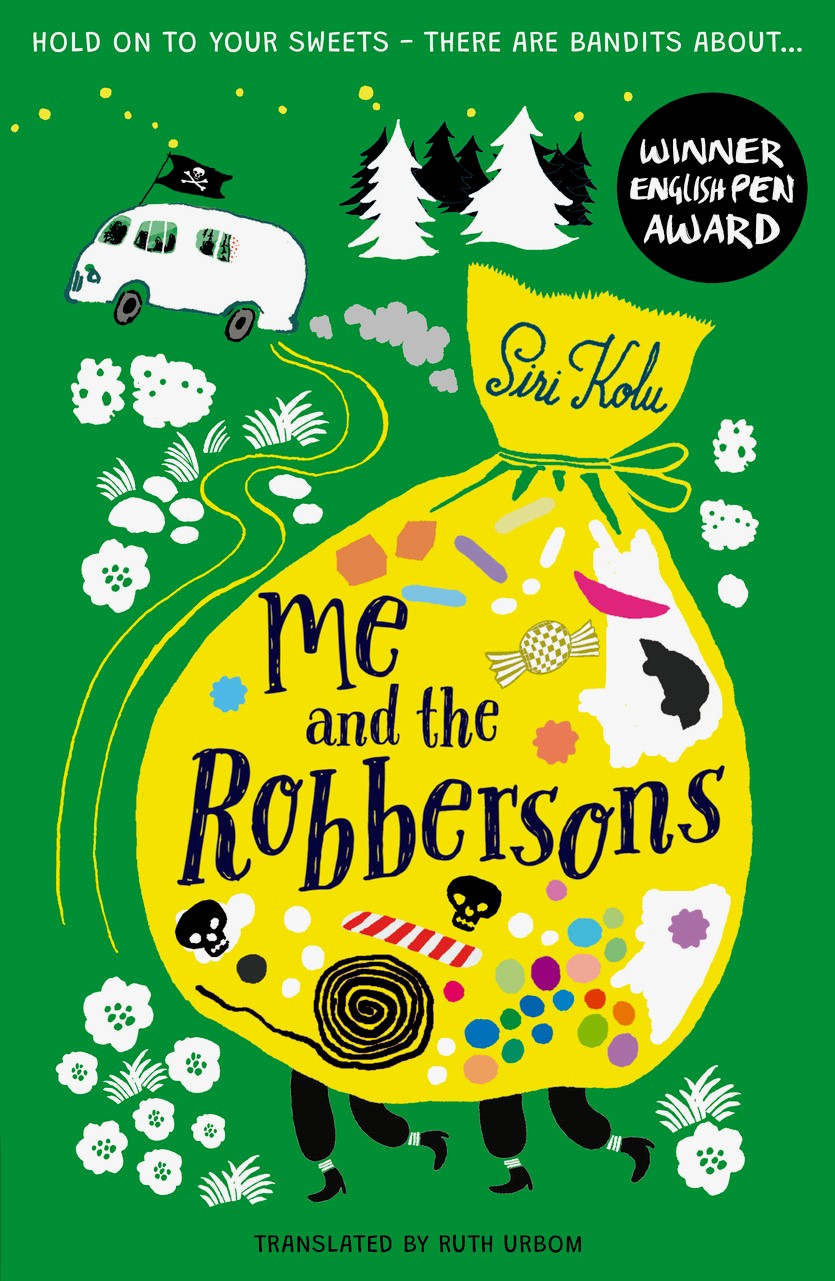
Why is Me and the Robbersons fun and whimsical? It is my gift of love to my son. The book started as a bedtime story for my five-year-old Martti, who felt that the world of brave fairytale heroes and Pixar characters was no longer for him. He commissioned me to write a story better suited for him. He wanted a tailored story, a story to fit him perfectly, with an ordinary child at the centre. No heroes, no superheroes, just a child. He also wanted the main character to be a girl.

I felt it was heart-warming that my son wanted to connect with me through a story. That sounds good, I said to my son, sure I could do this. Then I asked, “any more requests?” At that point my son was five, I had published my debut novel for adults and was working as a dramatist and as a script doctor. In short, I trusted my writing and I felt safe asking that.

Lesson of the story – if you want a real challenge, ask for requests from a five-year-old.

My son gave me a list. He wanted:

1) Fast cars chased by other cars, driving at high speed on winding roads.

2) Children high in tree tops, spying on the cars with binoculars. And these kids should be funny and clever and talk in a code language.

Umm, I thought. Code language? This sounds tricky.

But my son wasn´t quite finished. The most important thing still was missing from the list…

3) Candy! LOTS of candy. All the kinds of candy you can find. Pix ’n’ mix for sure. Lollies. Chocolate bars. Cotton candy. All sorts of candy. In enormous quantities, the largest amount of sugar-coated treasures I could possible invent. Anabundance of candy.

“Are you sure you got this right, Mummy?” my son asked with a worried look. “Are you writing it down? You can’t mess this up or you will spoil the story.” And since I am a grown-up with a “worn-out brain”, he instructed me once more. “Not the amount of candy for adults”, he added. “Not like a box of Tic Tacs. I mean the Serious Candy Business. I mean the candy feast for the kids, the candy professionals.”

Then it slowly sank in.  I knew nothing of this – I was a rookie. And I was in deep deep trouble.

But I learned. I started working on the story. I wrote and rewrote it and my son was the world’s harshest editor. “The boring bits” from the text needed to be deleted. “We leave just the yummies.” So we did. That was my second time at writing school twice and it made me the writer of children’s fiction I am today. I think it made me a better Mum as well. Now I know the candy business is Serious Business.

The story my son commissioned is called Me and the Robbersons. As of 2021 the book has been translated over twenty languages. The bandits in my story have run to countries like South Korea, Russia, Spain and Germany. I wrote about a funny bandit family who steal young Maisie to be a friend for their robber kids, but in fact the bandits stole me too! In Scandinavia I am called the Robber Mother. I have written a decade’s worth of bandit stories and seen them come to life in a film and in several plays for stage. I have created a bandit cook book, some bandit family games and quizzes. Even though I have a serious fear of flying, I was (before Covid-19) flying around Europe to meet the readers of the bandit story.

The best bit is that I receive some “Interesting Mail”, as my kids call it. I get lovely drawings of bandit vans and photos of pets, named after Maisie or Charlie of Wild Carl!

I need to make a confession. I think I am no longer an adult. I might be a ten-year-old in an adult-looking body! And I think I love it. Writing Me and the Robbersons changed me for the better. It changed my life, and I owe it all to my son.


Posted on Leave a comment

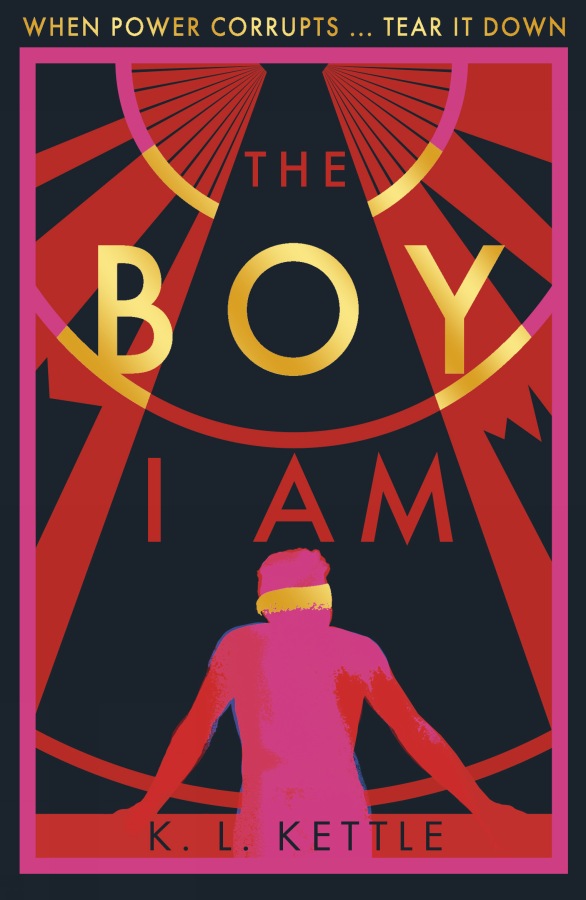
K.L. Kettle introduces The Boy I Am

When power corrupts…tear it down…The Boy I Am is the powerful debut novel from K.L. Kettle out now

Dear Reader,

I’m so excited for you to hold The Boy I Am in your hands.

I came to this story wondering what kind of feminist I wanted to be. Writing this book helped me process my own experiences from years working in a male dominated industry. There have been so many great times, but they’re pierced by moments when some men I worked for reduced me to something to flirt with, dismiss, or sideline when unwanted advances were met with polite declines.

Each moment sticks with me. I over analyze whether I dealt with them the right way, then wonder if there is a right way, then doubt my memory, then beat myself up for taking the burden of anxiety on myself, and so on… Sound familiar? You don’t need to be a woman to know these feelings, far from it, they come wherever there is disparity in power. And there’s a lot of that today.

The proverb ‘absolute power corrupts absolutely’ kept circling my mind as I found Jude’s story. If we are all equal, are we all equally capable of abusing the power we have? If so, how do we choose to be better?

See, I told you I over analyze.

From where it began, soon my research took me to some places full of sadness:

To forums teaching men how to manipulate women, where young men believe their worth is only in relation to their ability to be with a woman, or where they are radicalized and pressed into dark causes to compensate.

To charities raising awareness of the hidden problem of child marriage for both girls and boys in a world where thirty seven countries have no real minimum age of marriage, including the USA, and where the rules can be exploited, not only for straight and cis people, but often to force young LGBTQI people into marriage.

I saw the worst extremes of both gender rights movements and questioned my own identity and beliefs.

But…
And it’s a really important but…
I came out the other side with hope because of people I met along the way, working together despite their differences: activists for gender diversity and equality, for disability and anti- racism. I also came out with the comfort that things are, slowly, getting better. But it will take all of us working together to stop them from getting worse.

The realization I came to is that I am an unfinished feminist. And that’s how I want to be, always learning about the power I have, the systems I am a part of, and how I can work with those around me to strive for a better, more compassionate world.

I hope your journey of discovery is as powerful as mine.

K.

Posted on Leave a comment

The Most Wonderful Time of the Year…

Ellie Hattie – Author 

When my publisher asked me to write a book about what I love about Christmas my first thought was “Where do I begin!!?” 

And really, it was as straightforward as that! I started to list every single thing about the festive season that makes me smile, the tinsel, the baubles, the food, the songs, the gifts and presents. The friends! The family! And that’s when it struck me. The thing that I LOVE most about Christmas is the LOVE that it’s wrapped in. 

I remembered being small and the building excitement as all the Christmas decorations and smells started to accumulate in the house. But the loveliest piece of the puzzle, the cherry on the cake, the star on top of the tree, was being wrapped in hugs, full of love, by my parents on Christmas Eve and Christmas morning!

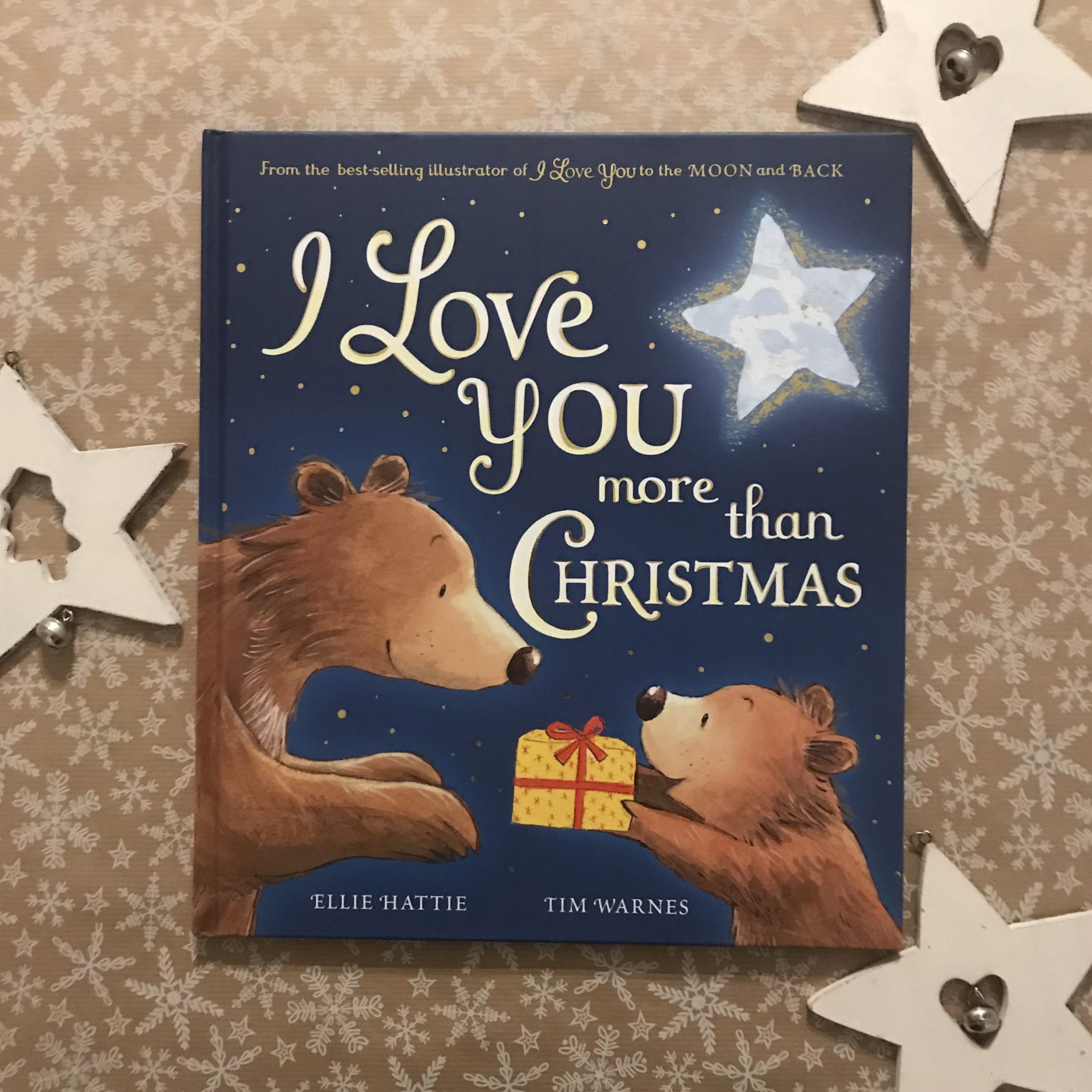
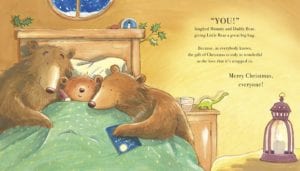
I knew that the fabulous Tim Warnes was going to illustrate the story and I couldn’t wait to see the characters come to life. There’s nothing more exhilarating than watching an artist work their magic, and the Bear family did not disappoint! Little Bear is so exuberant – the character’s joy radiates from the page with every furry smile and outstretched paw! And the final spread – the final hug – makes my heart sing every time I look at it. It perfectly captures that moment from my childhood that I remember so vividly. Of many merry Christmases, sandwiched between my parents, wrapped in love. 


Tim Warnes – Illustrator
Here’s the thing about bears. Everyone loves them – and so they are in big demand from publishers (which is why there are so many bear books out there!).
So, yes – I’ve created many bear characters over the last 25 plus years. Which always leaves me wondering: How can I make these bears look a little different?!
I had recently read an article by the mother of an overweight child asking, Where are the positive, fat characters in picture books? So I decided to make the little bear pretty chubby. And Daddy Bear? He received the big, heavy-eyebrows treatment!
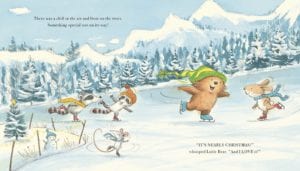
One idea that pleases me was beginning the story with little bear ice skating. I was racking my brain trying to think of an angle I’d not used before – and this was it! It’s a good demonstration of the illustrator’s role – to not only illustrate the text but also bring another layer to a story. This particular scene conveys a sense of movement and joy — an appropriate way to introduce the bubbly Little Bear!
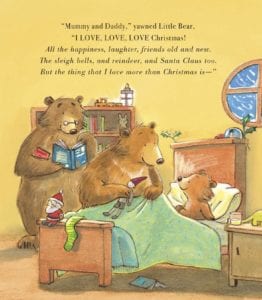
The penultimate illustration, though, is my favourite! I always looked forward to bedtime stories when I was a kid. And when I became a dad, it was still the time of day I looked forward to the most. Storytime, for me, is a snuggly, intimate time to pause and spend some precious quiet quality time together.
I hope I Love You More Than Christmas! will bring your family such treasured moments, too.