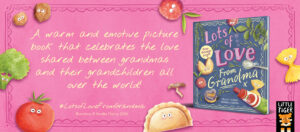
You could say that my journey to become a children’s picture book author was somewhat accidental. My husband and I were talking about a friend referring to a new baby in the family as a “little meatball.” I thought “Nonna’s little meatball” would be a fun idea for a book to celebrate Grandparents’ Day. I wrote some ideas on a Post-it note featuring foods from grandmas from around the world. I think that food is the universal language in how we express love, no matter what part of the globe you live on. My husband gave the Post-it note to Tom, the publisher at Little Tiger, and he drew some quick sketches while waiting for a plane at the airport. We had a Zoom call where I shared my ideas. Tom then said, “I’ll introduce you to your editor, and you can get started.” My gut reaction was, “Uh-oh, what have I got myself into? I’m not a writer.”
My inspiration for the book really came from my grandmothers, who were a big part of my life growing up. My amazing editor Becky helped me transform my sentiments about grandmothers and how they share their love and wisdom with their grandchildren into the lovely rhyming text in the book. My actual occupation is that I am a speech therapist who focuses on literacy. With a focus on literacy, there were some features of the book that were really important to me. I wanted the book to contain “print” embedded within the illustrations. Research shows that young children only pay attention to print 5% of the time when looking at picture books; 95% of attention goes to illustrations. You will find many examples of how the wonderful illustrator Monika Filipina embedded print within the layers of her illustrations.
Speaking of the illustrations, I think Monika really captured the nostalgia of what our grandmother’s kitchens and cooking looked like. Women often shared recipe cards and kept them in a binder; cookbooks were well-used, and favorite recipes were obvious by the stains on the page. Family meals were a special time when the table was set with china and a tablecloth. Monika lovingly designed the fabric designs in the book from tablecloths her own grandmother made.
Finally, the book is meant be given as a gift, which is why we put in the final page for a grandmother to share a favorite family recipe. It was important to me that someone could write the recipe, like an inscription, in their own handwriting. Our handwriting is like a fingerprint, unique to each person. I still get sentimental when I see the handwritten recipes my grandmother sent to me 32 years ago when I was a young bride. I hope that all the grandmothers out there enjoy reading it with their grandchildren as much as I enjoyed reminiscing about my grandmothers when I wrote it.

